
In 2025, FoodFacts was selected by the Swedish Food Retailers’ Federation (Svensk Dagligvaruhandel) to deliver carbon footprints for the entire food assortment across Swedish grocery retail, in line with the Swedish Food Carbon Footprint industry-wide methodology. The methodology was developed by RISE Research Institutes of Sweden on behalf of the Swedish Food Retailers’ Federation and the Swedish Food Federation (Livsmedelsföretagen). Today, these product-level carbon footprints support the day-to-day sustainability work of Axfood, ICA Sweden, and Coop Sweden, which together represent more than 90% of the Swedish grocery market. This is one of the most ambitious product-level climate data initiatives in Europe to date.
A standardized approach to carbon footprint calculations
FoodFacts’ work is based on extensive data collection, advanced calculations, and the consistent application of a common calculation methodology throughout the entire process. It is not only the methodology itself that is standardized; FoodFacts’ entire approach, from data collection and modelling to the final results, is designed to ensure that all carbon footprints are done in the same way. This makes these generic carbon footprints fully comparable across products, categories, and suppliers. The footprints cover all products of the retailer's portfolio: A-brands, private labels, fruits and vegetables, non-packaged food, as well as products such as in-store baked bread.
Through this collaboration, grocery retailers gain access to the same carbon footprints across their entire assortment, providing more precise data for calculating their Scope 3 emissions, driving their sustainability strategies, and prioritizing actions where they can make the greatest difference.
"For the first time, Swedish grocery retail has access to comparable carbon footprints for the entire food assortment, calculated according to a common methodology. This gives the industry a shared starting point that makes it easier to track climate impact, prioritize the right actions, and strengthen both operational sustainability work and climate reporting."
– Jenny Hagberg, Head of Sustainability at the Swedish Food Retailers’ Federation (Svensk Dagligvaruhandel)
How does FoodFacts calculate generic carbon footprints?
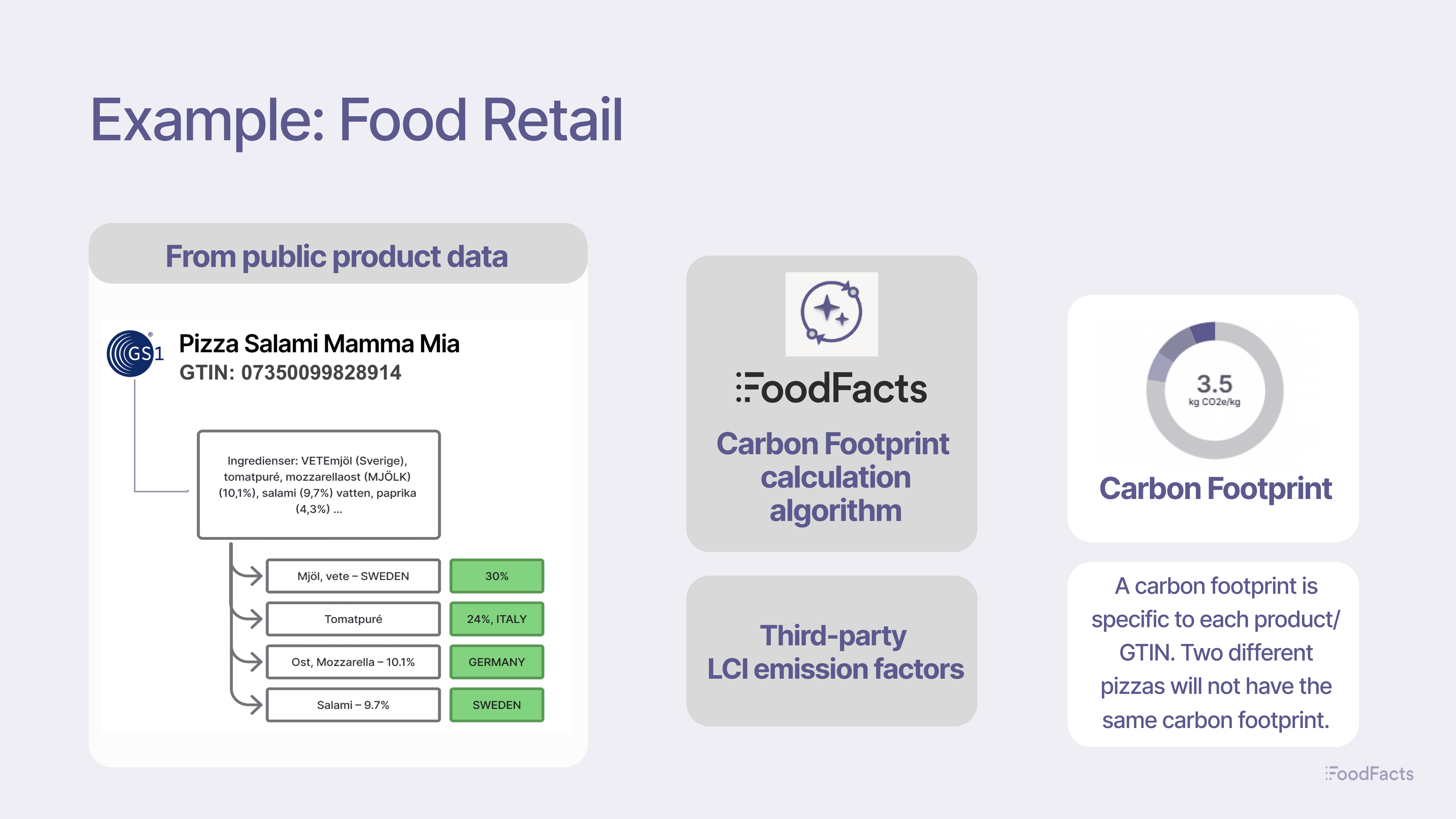
A generic carbon footprint is an estimated carbon footprint for a product, calculated using secondary and generic data sources representing different stages of the value chain. It provides a comparable and scalable estimate of a product’s climate impact across large product assortments.
The calculation is based on each product’s specific contents and characteristics, including:
Ingredients
Processing
Transportation
Consumer packaging
Step 1: Product data is collected
Product information is retrieved from industry-standard product data sources such as GS1, where producers provide information including:
Ingredient lists
Nutritional information
GPC codes
Packaging
Origin
Certifications
Because ingredient lists are provided as free text, the information is structured into a digital product recipe, identifying ingredients, quantities, and origins.
Step 2: Missing information is added
Some product information is typically missing or only partially specified. This information is completed through a process called data augmentation, using:
Statistical models
Nutritional data
Partially specified quantities
Certifications
Relevant market and industry information
This enables complete, product-specific profiles even when some data is missing.
Step 3: Ingredients are matched with emission factors
Each ingredient is matched with relevant emission factors and footprint data from established third-party sources, including SAFAD and the Agri-footprint (AFP) Life Cycle Inventory database. Using multiple data sources enables FoodFacts to select the most relevant, specific and up-to-date data available based on factors such as the ingredient, production method and geographical origin.
To ensure alignment with the industry-wide methodology, extensive work has been carried out together with database providers to review emission factors and harmonize system boundaries across different databases.
Step 4: Processed ingredients are accounted for
FoodFacts emission factors are developed at a highly granular level, covering more than just raw ingredients.
Processed ingredients are assigned an adjusted climate impact that reflects the full production chain and concentration effects.
For example, producing one kilogram of tomato powder requires several kilograms of fresh tomatoes as well as processing. As a result, one kilogram of tomato powder has an emission factor approximately 18 times higher than one kilogram of fresh tomatoes. The FoodFacts model captures these differences in its calculations.
Step 5: The full product footprint is calculated
The carbon footprint is calculated by combining the impacts associated with the different stages of the product’s value chain:
Ingredients
Processing
Packaging
Transportation
The contribution from each stage is calculated based on the product data and relevant emission factors. These impacts are then combined to produce the product’s total carbon footprint, expressed as kg CO₂e per kg of product.
Step 6: A generic carbon footprint is generated for each product
The result is a product-level carbon footprint for each product/SKU, calculated using the industry-wide methodology.
This approach enables FoodFacts to provide comparable carbon footprints across large retail assortments while taking into account the specific contents and characteristics of each product.
Want to learn more about how FoodFacts can help you calculate carbon footprints on your full portfolio? Read more about it here.
Generic carbon footprints vs. specific Product Carbon Footprints
The key difference between generic carbon footprints and Product Carbon Footprints (PCFs) is the level of product-specific data available for the calculation. Both use the same calculation engine and underlying methodology. Generic carbon footprints are typically the type of data FoodFacts provides to retailers, who often do not have access to detailed, company-specific product data.
Generic carbon footprints are calculated using available product information combined with secondary and representative data for ingredients, processing, transportation, and other relevant stages of the value chain. This makes it possible to generate comparable, granular carbon footprint estimates across large retail assortments, giving retailers product-level coverage without requiring detailed company-specific information from every individual supplier.
Product Carbon Footprints (PCFs) use more detailed, company-specific data from food producers, such as recipes, raw ingredients, production processes, energy use, and transportation. Where primary data is available, it can be incorporated into the calculation, while secondary data can be used to fill remaining gaps. This is the type of calculation FoodFacts can provide when working directly with food producers and their product-specific data.
The key is not having perfect data from the start, but being able to calculate footprints consistently with the data available and increase specificity as better data becomes available.
More about the industry-wide methodology behind the carbon footprints
The industry-wide methodology behind the carbon footprints is based on a Swedish industry standard developed by RISE Research Institutes of Sweden on behalf of the Swedish Food Retailers’ Federation (Svensk Dagligvaruhandel) and the Swedish Food Federation (Livsmedelsföretagen). It provides the foundation for creating comparable, transparent, and scientifically grounded footprints across the food sector. The methodology was first published in 2023 and has since been established as a common reference framework for footprints within the Swedish food industry. An updated version of the methodology is planned for publication at the end of 2026.
The methodology is based on common and clearly defined principles that ensure comparable results.
Some of the key principles include:
Common system boundaries: The calculations cover the product life cycle from cradle to farm or factory gate, including transportation to Sweden.
Representative data: Data must be selected so that the product’s carbon footprint reflects the underlying production systems, technologies, and geographical origins across the value chain. The data must be no more than 10 years old.
IPCC characterisation method: All greenhouse gas emissions are converted into carbon dioxide equivalents (CO₂e) using the characterisation factors recommended by the IPCC.
Clear allocation principles: For food systems where multiple products are produced simultaneously, established allocation methods are used to distribute emissions consistently between products.
Land use and biogenic emissions: The methodology includes emissions from land-use change, such as deforestation, as well as emissions from organic soils.